Showing posts with label Elections. Show all posts

Tuesday, November 6, 2012

The most boring election ever

I have avoided posting anything about the US election for all sorts of reasons. The two main candidates are both awful, the soundbytes are nauseating, the jingoism is unbearable. But mainly I haven't cared that much because this election has pretty much been a foregone conclusion for the last 18 months.
The Republicans spent all of 2011 and most of 2012 tearing strips off each other in the attempt to pick a candidate. They ended up with Romney who ended up taking most of the flak in the endless GOP debates. But given the opposition, especially Cain, Bachmann, Gingrich and Perry, that came as no surprise. On the other side you had a slew of big name Democrats clearly declaring they weren't even going to challenge Obama in the primaries.
So it should come as no surprise, as polling stations open in the US, that Obama is being given somewhere around an 80-85% chance of being re-elected. The crazies in the GOP be they Tea Partiers, Birthers, Religious Right, Creationists and what not have alienated many potential centre-right voters who will either stay at home or vote Obama.
The other key thing to note is the inherent bias in the electoral college system towards the Democrats. The winner takes all system provides a huge head start to Obama in guaranteeing him New York, California and Illinois of the big states (104 votes already) whereas apart from Texas (38 votes) all the guaranteed Red states are pretty small in electoral college votes. The New York Times has a great visualization of just how difficult it is for Romney to win even with 9 swing states in play.
So four more years of Obama. Well it's better than four years of Romney but then what wouldn't be better than a Romney presidency? I guess we can look forward to a few less wars, a few more rights for women and the gay community. But the US is still going to remain a very divided country both along the Red/Blue divide and the 1%/99% divide. Maybe in 2016 when we get a Hilary Clinton v Chris Christie or Marco Rubio contest we might actually have something to watch. Tonight I'll definitely be going to bed early.

Thursday, June 21, 2012

Constituency Commission report

Back around the New Year, between washing bottles and changing nappies, I wrote a series of posts that formed the text of my submission to the Constituency Commission that were reviewing the boundaries of Dáil constituencies. Finally, after the Fiscal Compact referendum was dealt with, the Commission has reported. I'm not going to go over the report in exacting detail, rather I'm going to make a few general observations and then pick out a few interesting details.
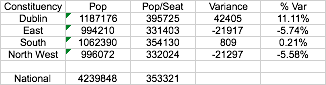
Firstly, the Commission has really missed an opportunity to undertake serious reform of the electoral landscape. As my submission showed, it is possible to maximize the number of five seat constituencies without breaching the guidelines much more than the Commission have in their own report. Taking south Dublin as an example, they have butchered an existing five seater into a three seater their attempts to keep a viable Dun Laoghaire and expand Dublin South West. This missed opportunity is even more clear in the European constituencies. As the Commission note themselves, most of the submissions received suggested a move to 3 four seaters but they have plumped for leaving things as is, not withstanding the fact that this leaves Dublin under represented by almost 11%.
The big losers in this redrawing are FG. Most constituencies that have been severely changed seem to hit them the hardest and any improvements are not sufficient to pick up additional seats. While again the Dublin South example springs to mind, the same is true in Donegal where Dinny McGinley's seat could be vulnerable to a small FF bounce in the newly extended five seater. Similarly they are fairly banjaxed around Cork city with the loss of a lot of Jerry Buttimer's natural territory to North Central.
The largest number of submissions to the Commission were on the Swords issue and having ignored the issue last time out, I am glad that Swords has been reunited into a single constituency. Less pleasing to me is the pandering to the upwardly mobile of East Kimmage, or West Terenure as they call themselves, and their inclusion into the stupidly named Dublin Bay South. From a personal point of view it makes it almost impossible to hold two Labour seats in the constituency short of a miracle. Creighton and Murphy must be celebrating this evening with Andrews having a tipple or two as well.
So what's next? The Oireachtas has to now enact an Electoral Act that enshrines these new boundaries into law. It is almost beyond contemplation that the recommendations would be tinkered with by the Oireachtas, thereby undermining the independence of the review. But based on Phil Hogan's recent track record one can never be too sure, even though his own Carlow-Kilkenny constituency is left unchanged.
The local election boundaries will also have to be redrawn now to conform more closely to the D&aacuute;il constituencies. I imagine that process will start over the summer with submissions accepted up until the end of the year. A report in February/March will allow for more than a year's bedding in before the local and European elections in June 2014. Time to crank up the spreadsheets and mapping software again!
P.S. I have been informed by Chris Andrews via Twitter that he does not partake of alcoholic beverages. I apologise for any slur to his good name implied by my above comment!

Tuesday, January 24, 2012

Gender Quotas

Last Friday there was an all-day conference held in Dublin Castle on the topic of how to get more women elected in Ireland. Unfortunately I wasn't able to attend due to work commitments but from what I heard it was extremely well attended with good contributions from all participants. Of course, we won't mention the fact that less than 10% of those at the conference were male - so much for equality!
Anyway, the main strategy being pursued by this government is the introduction of gender quotas at candidate selection for political parties. The target is currently set to 30% at the next general election and this figure rises to 40% after a further seven years. The stick which which the parties will be hit is a 50% cut in funding from the public purse.
I am all for improving the representative nature of politics, not just women, but across income, education, age and ethnic divides, so I am generally in favour of the proposals. I certainly wouldn't go as far as Dan Sullivan's article in Friday's paper calling them boneheaded. However, there are a few items that I want to comment on.
No sunset clause
The use of gender quotas was sold during the last general election as a temporary measure to increase women's participation. Once a critical mass of women were elected there would be no further need for quotas as the number would be self-sustaining. Therefore rather than increase the target after seven years the measures should be rescinded.
Effect on small parties
The large parties (namely FG, Labour, FF and SF) should have no difficulty in reaching the mandated target. However, for smaller groups like the Socialists or a brand new party, who only have resources to run a few candidates and only a few people willing to stand, a cut in half their state funding could be fatal. There should be a minimum threshold of candidates below which the quota does not apply.
Only applying at General Elections
The quotas, and resultant cut in public funding, will only apply at general elections. Local elections are the training ground for new politicians and there are few candidates for larger parties in generals who have not already fought, if not won, a local election. If we were serious about increasing the number of women elected to the Dáil then the locals should have been included in the quota.
Selection convention chaos
There is going to be all out war at selection conventions across the country as local organizations have their decisions overturned and/or additional candidates imposed from Head Office as the party machine tries to ensure meeting the quota to ensure continued funding. This is going to be especially difficult for FG as they only managed to field about 15% women last time and have a lot of incumbents to accommodate.
One report I did hear from the meeting last Friday was repeated tales of women "being asked" to stand for election and of women not standing because "they weren't asked". This I don't understand, especially coming from the group of intelligent and capable women that spoke at the conference. Surely in this day and age you should just choose to stand and then build a campaign and a team around you. Not everything can be delivered on a plate you know!

Friday, December 30, 2011

Review of Dail Constituencies (Part 5)

In this final part, (Part 1, Part 2, Part 3, Part 4) we come to the jewel in the crown, the crème de la crème, the pièce de résistance, Dublin. Ok, so it ain't all that, but for the amateur constituency maker it provides the greatest opportunity for creativity while still remaining within the guidelines laid down by the legislation. In keeping with the rest of my carve up, we will be maximizing the number of large constituencies. So lets take a look at how the 44 seats allocated to Dublin can be best divided to create eight 5-seaters and a single 4-seater.

To paraphrase Caesar, Dublinium est omnis divisum in partes duo. The Liffey forms the boundary between the Northside and the Southside and so we will follow suit and maintain this boundary. North of the Liffey there are just under 580,000 residents while just over 690,000 people live South of the river. Dividing the allocated seats proportionately we get 20 TDs for the Northside and 24 TDs for the Southside. This means we will create four 5-seaters on the Northside with four 5-seaters and a single 4-seater on the Southside. The map here shows my proposed boundaries.

North Dublin

Currently there are 6 constituencies with 21 seats in North Dublin. In the infamous Tullymander, the Dublin area was divided into many 3-seaters. Then for the 1981 election the boundaries were redrawn to create 4-seaters in urban areas. However, due to dropping population levels compared to the rest of the country, over the last 30 years each of Dublin North-East, Dublin North-Central and Dublin North-West have been reduced to 3-seaters, losing territory to neighboring constituencies to minimize the population variance. I propose that the current boundaries are not fit for purpose and suggest that it is now time for a major redrawing, ignoring the requirement for continuity as it is the least important requirement in the legislation.

Starting at the top, the major issue in Dublin in the last redraw was the division of Swords between Dublin North and Dublin West. I propose this be reversed and that Swords-Forrest rejoin Dublin North. The addition of Portmarnock, Balgriffin and the Airport will bring Dublin North up to the required level of population for a 5-seater. What remains of the existing Dublin North-East should then be merged with almost all of the existing Dublin North-Central to form another 5-seater which I am going to call Dublin North-East. The only transfer required here is the DED of Drumcondra South A out of the new constituency.

On the 2011 census figures, the existing Dublin Central already has just about sufficient population to warrant remaining a 4-seater in our reduced 160 seat Dáil. However, we are aiming for 5-seaters so we need to transfer in around a total of about 30,000 people which we will take from the existing Dublin North-West constituency along with Drumcondra South A which we have already ditched from the new Dublin North-East. By absorbing most of the Ballygall and Whitehall DEDs along with Ballymun C and Beaumont A we get a total population of just under 147,000 which is fine for a 5-seater.

This leaves the remains of old Dublin North-West (Finglas and Ballymun mainly) and old Dublin West (Blanchardstown and Castleknock). These areas combined have a population of almost 146,000 which again is just right for a 5-seater. I am calling this area Dublin West, but it could just as easily be called Dublin North-West. This completes the division of Dublin north of the Liffey.

South Dublin

Moving to the Southside, we need to create four 5-seaters and a 4-seater from the existing mix of two 5-seaters and four 4-seaters. This represents a loss of two seats and one constituency. There are several ways to carry out this division but I feel that the cleanest is to disband the existing Dublin South-Central constituency and divide its territory into its neighbours, bringing each up to the required population level.

Starting in Dún Laoghaire, we are short about 0.3 TDs worth of population to maintain the constituency as a 4-seater. I propose returning some of the DEDs on the western side of the N11 back from Dublin South that were transferred during the last boundary review, namely Foxrock-Carrickmines, Cabinteely-Loughlinstown and Shankill-Rathmichael. This provides an increase of about 15,000 in population which brings the constituency in line with the requirements for a 5-seater.

Having lost 15,000 to Dún Laoghaire, Dublin South finds itself needing a similar increase in population to keep its 5 seats. This can be achieved by adding Firhouse-Village. This allows us to retain the Dodder as the northern boundary of Dublin South for most of its length. This border also means that for Dublin South-East to move from a 4 to a 5-seater it must expand westwards into the old Dublin South-Central. This requires adding the DEDs of Merchant's Quay and Ushers as well as the areas of Crumlin C, Kimmage C and Terenures A and B. This serves to unite the south city centre into a single constituency, much as Dublin Central serves the entire north city centre, while also retaining some balance between high and lower density areas by uniting Harold's Cross and most of Terenure into a single constituency.

Dublin Mid-West then expands eastwards into Kilmainham, Inchicore and Crumlin as well as taking all of Clondalkin-Monastery. To keep the population within limits we need to transfer the semi-rural DEDs of Newcastle, Rathcoole and Saggart to Dublin South-West. This leaves Dublin Mid-West at 147,000 which is acceptable for a 5-seater. The transferred DEDs along with the remainder of the old Dublin South-Central (mainly Walkinstown and Templeogue) when added to Dublin South-West give us a constituency with just over 139,000 which, although slightly lower than average, is still acceptable as a 5-seater. It should also be noted that some of the DEDs in the new Dublin South-West had population increases of between 22% and 51% since the previous census and so it is expected that the variance will decrease over time.

Dublin Summary

The table shows the population and variance of each of the new Dublin constituencies. As we expect most of the constituencies have a slightly positive variance. This is due to the region being under-represented by 0.4 TDs which was felt a reasonable thing to do to increase slightly the representation in Connacht/Ulster earlier on.

Local Tweaks

One thing that needs to be checked is the precise alignment of the boundaries of constituencies with the boundaries of the DEDs. This is because, in most cases, the DEDs pre-date a lot of development, especially in suburban areas in Dublin. For example, in the map here, we have a close up of the boundaries between my Dublin South-East, Dublin Mid-West and Dublin South-West constituencies. The logical divider should be the Crumlin Road from the Canal to the Children's Hospital and then the Drimnagh Road and Long Mile Road as far as the Naas Road.

However, the marked area to the north of the Long Mile Road is actually part of the Walkinstown A and Clondalkin-Ballymount DEDs which straddle the main road. In this case it would be sensible to split the DEDs and put the parts on the north side of the road into Dublin Mid-West, leaving the parts on the south of the road in Dublin South-West. Due to the land use (mainly commercial and industrial) not much population would change with this modification but it would make the boundary between the Dáil constituencies much clearer.

Similarly the section of Crumlin Road near the canal actually bisects the Crumlin C DED. Again it may make more sense for the constituency boundary to follow Crumlin Road rather than turn left onto Herberton Road. However, this would result in some population shift between Dublin South-East and Dublin Mid-West so care would have to be taken not to put Dublin Mid-West over the 30,000 people per TD limit. This would be possible with access to the Small Areas database which is more fine-grained than the DEDs.

Conclusion

In this series I have shown that the Constituency Commission can tackle the problems associated with 3-seater constituencies without breaking too many of the guidelines set out in their terms of reference. The table shows that I have managed to reduce the number of 3-seaters from 17 down to 2. The quantity of 4-seaters has also been reduced from 15 to 11 while the number of 5-seaters has doubled from 11 to 22. These posts will be amalgamated into somewhat coherent English and submitted to the Commission in the coming days. I hope that they will follow my lead and try to consign the 3-seater to the dustbin of history where it belongs.

Sunday, December 18, 2011

Review of Dail Constituencies (Part 4)

Leinster (excluding Dublin)

Compared to the shenanigans required to get Connacht/Ulster to work, Leinster outside of Dublin turns out to be fairly straightforward. The table here shows the number of TDs per county based on a 160 TD Dáil with a total of 43 to be distributed across the region.

The southern counties arrange themselves neatly into three 5 seaters. Wexford is pretty much spot on for 5 seats, Carlow and Kilkenny combined are slightly over the required population for 5 but not by much, and Wicklow on its own is slightly below, but again not by much. In the current constituencies the north-eastern DEDs in Carlow are transferred across to Wicklow to balance up the populations more exactly. This is easy to do but I believe that the desire to avoid breaches in the county boundaries is stronger than tweaking the population to reduce variances.

Since the foundation of the state the constituency of Laois-Offaly has existed, initially as a 4 seater but for most of its history as a 5 seater. However, due to substantial population growth, the area is now entitled to 5.5 TDs in a 160 seat Dáil and so some territory needs to be shed. In the previous arrangement the most southerly DEDs in Offaly were transferred to Tipperary North. However, I want to keep the provincial borders intact and so propose removing a total of 7 DEDs from Portarlington to Edenderry from Laois-Offaly and adding them to Kildare. With these additions, Kildare's total representation increased to 8 in total. By moving the Robertstown and Downings DEDs from the existing Kildare North into Kildare South and adding the DEDs from Laois-Offaly to Kildare South as well we end up with three well balanced constituencies.
In the last boundary review, two DEDs around Drogheda were added to Louth as it was determined that they had more in common with the town than with the rest of Meath. If these remain in the Louth constituency then no changes need to be made to allow the constituency retain 5 TDs. This population transfer is not sufficient however to create a 5 seater of the remainder of Meath. I propose transferring the western DEDs of the county from Oldcastle, through Athboy and down to beside Kinnegad across to an expanded Longford-Westmeath constituency. This then forms three 5-seaters covering the northern end of the province.

This map shows my division of the non-Dublin section of Leinster, comprising of seven 5-seaters and two 4-seaters. A summary of the new constituencies is contained in the table. As can be seen the maximum variance occurs in Carlow-Kilkenny and Wicklow which as mentioned previously can be remedied if required by transferring DEDs from Carlow to Wicklow.

Munster


Munster lies somewhere between Leinster and Connacht/Ulster in terms of difficulty to arrange into new constituencies for a 160 seat Dáil where the emphasis is on creating larger constituencies. Three counties, namely Clare, Kerry and Waterford are nicely populated to form constituencies in their own right with 4 seats for Clare and Waterford and 5 for Kerry. I am sure that there will be calls to retain two 3-seat constituencies in Kerry but this would only be possible with a transfer of in excess of 20k people into either or both constituencies. Instead, with just over 2k people above the average, Kerry as a whole is properly represented as a 5-seater.

Cork's population entitles it to 18 TDs in our reduced size Dáil. At present there are two 3-seaters, two 4-seaters and a 5-seater in the county so overall one TD will have to be cut. I propose a significant redrawing of the boundaries within Cork, with the aim of removing as many 3-seaters as possible. To that end, I start by creating a Cork City constituency covering the City Council area along with the northern suburban DEDs of St Mary's, Rathcooney, Riverstown and Caherlag. Next I create a Cork South constituency covering the suburbs of Douglas, Ballincollig and Carrigaline as well as the towns of Cobh, Kinsale and as far down the coast as Clonakilty. The existing Cork East is expanded to take in the more rural parts of the existing Cork North-Central. The remained of the county is merged into Cork West along with the transfer of Mallow from Cork East to Cork West.

This leaves Limerick and Tipperary to sort. Limerick is entitled to 6.6 TDs and Tipperary to 5.6 neither a particularly good number. However, were we to transfer approximately 10k from Tipperary into Limerick then we could make a 5-seater for Tipperary, and split Limerick into a 3-seater for the city area and a 4-seater for the country. The areas I have chosen to move are those around Birdhill and Ballina which have essentially become commuter towns for Limerick city.


The table shows the population and variance for each constituency in Munster. As can be seen we have minimized the number of small constituencies, remained within county boundaries except in one situtation and have kept the variance in population within acceptable bounds. Further minor tweaks could be made to the boundaries to further minimize the variance within Cork and between the two Limerick constituencies.

In the final part of this series I will tackle Dublin and then make some overall conclusions about my choices across the country.

Saturday, December 17, 2011

Review of Dail Constituencies (Part 3)

Constituency Sizes

In the previous two parts (here and here) we have established that in the current review the target number of TDs should be set to 160. However, the Commission is free to create 52 three seat constituencies or 32 five seaters or any combination between those extremes. It is my strong personal belief that larger constituencies are better in the PR-STV system as they increase the proportionality of the set of representatives elected.

In the extreme case of single seat constituencies, where PR-STV degenerates into AV, a party could win 49% of the vote in every area and still not win a single seat. This result is highly unlikely of course but the system makes it possible. As the number of members elected by each constituency is increased the proportion of votes . Since the commission is limited to 3, 4 and 5 seat constituencies, I will try to maximize the number of larger constituencies and only use 3 seaters where absolutely necessary to try and fulfill the other requirements placed on the Commission by the legislation.

Division by Region

Taking the 2011 census figures region by region we see that the number of TDs per region should be as follows:


This table starkly shows the growth in population in the Dublin commuter belt compared to the rest of the country. Despite losing 6 TDs from the Dáil, this region actually gains representation. It also shows how few TDs should be assigned to the vast area of Connacht/Ulster, reflecting the relatively low population density in the North and West of the country. Finally, we can see that after the re-drawing, Dublin will still remain the key battleground in any General Election with the largest share of seats up for grabs in the capital.

As a child, my grandmother talked about giving homework a "quick death" by doing the simple things first. In modern management speak that'd be picking off the low hanging fruit. But that always ended up leaving me on a Sunday night with both an Irish and an English essay to write. So this time I'm taking on the toughest task first.

Connacht/Ulster

This is by far the trickiest region to divide into constituencies. The guideline to remain within county boundaries conflicts directly with my desire to minimize the number of 3 seat constituencies. To this struggle we add the relentless calls for the re-unification of Leitrim into a single constituency. This has been a major issue in the public consultation of both this and the 2006 constituency review. To help ease the pressure I am adding the fractional TDs from Dublin and Munster to the Connacht/Ulster. This will bring the total number to be allocated up to 30.

Galway West and Galway East both retain enough population to maintain their current representation of 5 and 4 seats respectively. To rebalance the constituencies more precisely, a total population of about 1200-1500 in one or two of the most easterly districts, Aughrim, Stradbally, Deerpark or Bellville could be moved from West to East but I deem this an unnecessary change in the overall scheme.

In a 160 seat Dáil, Mayo is entitled to 4.6 TDs and Roscommon is entitled to 2.2 TDs or a combined total of 6.8 TDs. I propose creating a 4 seat Mayo and a 3 seat Roscommon-East Mayo constituency. This involves transferring about 18k people from Swinford and Ballyhaunis to form the East Mayo section of the three seater. This leaves both constituencies slightly below the average ratio but within acceptable levels.

The Cavan-Monaghan constituency should have 4.6 TDs. I propose leaving this area with 5 deputies despite that putting them 6.8% below average representation. The alternative would involve moving sections of West Cavan into a constituency with Leitrim or acquiring sections of neighbouring counties in Leinster, neither of which is overly satisfactory.

This leaves Leitrim, Sligo and Donegal. Between them the three counties have an entitlement to exactly 9 TDs which I will divide into a 5 seater covering most of Donegal and a 4 seater covering Leitrim, Sligo and the southern part of Donegal around Bundoran and Ballyshannon.


As can be seen from the table above, six of the seven constituencies have a negative variance, indicating that they are slightly over-represented compared to the national average. However, as mentioned previously, this is expected as we have assigned an additional 0.8 TDs to the region to compensate for the large geographical area.

In the next post I will tackle some lower hanging fruit in the shape of Leinster (excluding Dublin) and Munster.

Sunday, December 4, 2011

Review of Dail Constituencies (Part 2)

Part 1 of this series can be found here

Terms of Reference

The terms of reference of the Constituency Commission are set out in the Electoral Act of 1997 with subsequent amendments. It lays out fairly clearly the scope within which the Commission have to act in preparing their report.
  1. The number of TDs shall be between 153 and 160. This is a reduction from the original range of 164-168. As far as I know, in previous reviews the Minister issued a further instruction to keep the number of TDs static at 166. This is the first time that the Commission has had free reign to chose the final number of TDs for the country.
  2. All constituencies must have 3, 4 or 5 TDs. Gone are the days of 8 and 9 seaters which may be for the best.
  3. Constituencies must remain within county boundaries if possible. It always amuses me that we are so wedded to the English imposed system of counties, especially the strength county identity has in politics and the GAA. But people seem to like voting along county lines so we try to match our dividing to the pre-existing, arbitrary carve up.
  4. Each constituency must be contiguous. This is a good thing™ as enclaves and exclaves just make for confusion.
  5. Constituency boundaries should be aware of geographic features such as rivers, mountains and major roads and use them appropriately. There is also mention of awareness of population density which I'm not really sure about. Does it mean that each constituency should try to have the same density, which I don't think could work, or that the population density across a constituency should try to be uniform - ie keep urban areas together in one constituency and rural in another?
  6. There should be some consistency between the constituencies before and after the review. This rules out a wholesale redrawing of the map. I'm not surprised this was added by politicians when drawing up the legislation as who wants to have to learn about a whole new constituency every election. However, it does rule out a project like eliminating 3 seaters entirely.
The current review faces a few contradicting instructions due to the change in the overall number of TDs. They mainly come about from the continuity clause, which, it must be noted, is subordinate to all the others.

There are two ways to reduce TD numbers. Firstly you can reduce the number of constituencies by splitting say a four seater and divesting its territory into three surrounding constituencies while only adding a single new TD to each. The alternative is to keep the number of constituencies fixed and turn 5 seaters into 4 seaters and 4s into 3s while shuffling a few DEDs around to keep the population ratios in check. The former is directly at odds with continuity but the latter reduces the overall representativeness of the Dáil.

European Constituencies

While Ireland is historically divided into 4 provinces, for European electoral purposes the split is done slightly differently - Dublin forms a constituency on its own, Munster minus Clare is called South, Leinster minus Dublin, Longford and Westmeath forms East and then Connacht, Ulster along with Clare, Longford and Westmeath make up the North West constituency. With only twelve seats to be distributed that makes each constituency a three seater. The table below shows the distribution of population in each of the four regions.


As can be seen, Dublin is under-represented compared to the rest of the country with only the South region being close to the average. However, in a four way split, there is no straightforward way to remedy this without sub-dividing Dublin further, perhaps moving the Dublin North constituency into East.

An alternative solution that substantially reduces the variance is to re-draw the boundaries to form three constituencies of four seats each. In this scheme I create East, North and South. East consists of Dublin and Kildare. I then extend a line across the south border of Laois and Offaly as far as the Shannon and then down the river to the sea. All counties above the line form the North constituency with those below forming South. The numbers for this division are shown below.


While East is now slightly over represented at the expense of the other two regions, the variances are much smaller. The North constituency now also stretches from Malin Head to Abbeyleix, but considering the existing North West already goes as far as Cratloe outside Limerick it's not much longer. While it may not suit the North candidates to have to canvass such a large area, as the Presidential election showed, even on a small budget, a campaign can cover a large area if properly planned.

Thursday, December 1, 2011

Review of Dail Constituencies (Part 1)

Introduction

The boundaries of electoral constituencies are not carved in stone. As populations change in areas and the desired ratio of population to politicians changes so too must the boundaries. In the past this activity was in the direct control of the Minister for the Environment (or more accurately the Minister for Local Government at the time) but after incidents like the Tullymander in the 70s this power was passed off to an independant commission in the Electoral Act of 1997. The Constituency Commission is headed up by Justice Cooke and includes the Clerks of the Dail and Seanad, the Secretay General of the Dept of Environment and the Ombudsman.

Following the preliminary results of the census in April, the Minister has instructed the Commission to have another look at the Dáil boundaries, specifically asking them to reduce the number of TDs to between 153 and 160. There is currently an open call for submissions to the Commission and this series of blog posts will be distilled down to something vaguely coherent and sent to them on my behalf. The closing date is sometime in mid January so other interested people have time to do some thinking. It seems at the moment that the unify Leitrim and Swords campaigns are going to dominate the submissions.

Population

The preliminary 2011 census figures put the population of Ireland at 4,239,848 which is up 341,421 (8.1% over 5 years or 1.6% per annum) from the 2006 census total. While the Commission can only work on exact figures from the CSO and not projections, as detailed in the 2009 Electoral Act, it is worth looking a bit forward. The next General Election is not scheduled until February 2016, but it is possible that date may be brought forward to Summer 2015 to allow for better campaigning weather and higher turnout. The table below outlines the potential population per TD over time under four growth models: 1.6% per year as national population increased 2006-11, 1.4% per year as Dublin population increased 2006-11, 0.8% - half the national rate, and 0.7% - half the Dublin rate.


The cells in red mark the points at which the representation falls outside the thresholds mandated by the constitution of between 20,000 and 30,000 people per TD. As can be seen, even in the lowest growth model, reducing the number of TDs to 156 would cause problems come 2015. Using the highest growth model, we are in trouble almost immediately at the lower range of TDs and even by 2015 having 160 TDs would be too few for the constitutional limits. After the 2016 census will likely have to increase the number of TDs again to get the ratio back below the 30,000 limit. Of course there is nothing preventing either a specific referendum or the forum on the constitution from modifying the ratio in which case the issue may disappear.

Ideal number of Politicians

For many, the ideal number of politicians is either zero ("they're all useless") or one ("put me in charge as dictator"). However, studies have shown that most national parliaments have a number of members in line with the cube root of the population. In Ireland's case this turns out to be 161.85 national politicians. Were the proposed dissolution of the Seanad to happen, it would turn out that the Dáil as currently constituted would be pretty close to the ideal number of members. A reduction to 160 would be perfectly acceptable but the more we cut the further away from the ideal we get.

In announcing the formation of the Commission, Minister Phil Hogan claimed the review would be a "real, tangible reform" making the system "leaner and more efficient for its citizens". Now in all honesty, does the Minister really think that cutting the number of TDs is a real reform? All it does is reduce representation to save money. I would much rather a cut of 10% in the costs of running the Oireachtas than a cut of 10% of its members. But I guess he has to take a fairly populist line in this era of austerity and have politicians being seen to be taking the pain alongside the little people.

Coming Next

In the next few posts I'm going to have a look at how a potential 160 seat Dáil might be constituted, taking a fairly high level view of the provinces and going into a bit more detail in the Dublin area where I have a better understanding of the lie of the land.

Part 2 here.

PS - If anyone has any great experience of using qGIS or other free shapefile modifier please get in touch to help me draw some pretty maps of my carvings! The CSO kindly provide population and geographical breakdowns of every DED in the country for personal and educational use but I'm a bit lost at sea!

Friday, September 16, 2011

And then there were four, no five, no six, no seven

The presidential election has certainly sparked to life again in the last few days. Firstly Davis and Gallagher rustled up the requisite number of councils. Then Norris started playing the Lanigan's Ball game - in then out then in again. Next Fianna Fáil get back in the game with rumours of Lamhrás Ó Murchú planning a run. The just this afternoon news is leaked that Martin McGuinness will be the Sinn Féin candidate. Phew! Lets look at each of these bits one at a time.

Early on in the week both Mary Davis and Sean Gallagher managed to secure nominations from at least four county or city councils, making them the third and fourth official candidates on the ballot paper after Gay Mitchell and Michael D Higgins. Not content with four nominations, Davis continued to have motions of support passed ending up with around 10. To my mind this was a bit of a risky move. While supporters will argue that it shows she has the backing of people from around the country, I think that it will be more played as a blocking move, using up nominations so that other candidates can't enter the race. This is certainly the line that Gallagher took, requesting that motions to support him be removed from the agenda at other council meetings once he had his four secured.

The David Norris re-appeared. We all know how his previous exit from the race went (here and here) so I am hugely surprised that he is trying to come back. True, he finished his speech with the phrase "fail better" but I wasn't really expecting him to prove it so quickly. The issues surrounding his withdrawal haven't changed or gone away. I am also pretty sure that a good number of his previous Oireachtas supporters have left him, not to mention his campaign staff. He also returned all his campaign finances and so is starting from scratch. I don't expect to see his name on the ballot paper come polling day.

Micheal Martin really can't win on this one. Having decided to not put forward an official Fianna Fáil candidate, he should have issued an edict that TDs and Senators were to not get involved in the nomination game. However, he left the door open and talk started about FF members nominating someone who wouldn't be an FF candidate. Then to top it all off, Lamhrás Ó Murchú, the FF Senator who lost the whip over the civil partnership bill last year, has indicated a desire and willingness to stand. Of all the people FF could put up, Ó Cuív and Crowley being the obvious choices, Ó Murchú is pretty much near the bottom of the list. FF should be just concentrating on the Dublin West by election and scoring points against the government in the run up to the budget.

Our latest entry to the field is the Deputy First Minister from the North, Martin McGuinness. He is the best choice they have since Pearse Doherty doesn't meet the age requirement. Of course, SF only have 17 Oireachtas members so there are three others signing his papers. I'm guessing they'll be from the ranks of the ULA. Of course the announcement had to be delayed until today so McGuinness can apply for the 6 week sabbatical from being DFM, much as Peter Robinson did during the UK General Election. It will be very interesting to see how both the media and the other parties treat the entry of SF into the race. Given the absolute destruction that was rained down on Norris I'm looking forward to seeing a similar level of investigation into McGuinness. I don't expect him to win, but they will poll a respectable 12%-15% which may put them third on the first count. I think they would count that as a victory, especially given the lack of an official FF candidate.

Friday, July 8, 2011

Thoughts on Roscommon Hospital

Much has been made in recent days about James Reilly's plans to close down the A&E service in Roscommon Hospital. He claims that the unit is unsafe and that patients are at more risk by being treated there than by traveling to Galway, Longford or Castlebar. This resulted in FG TD Denis Naughten losing the whip after voting against the government on the issue.

In my mind there are two major issues at play here. Firstly there is the conflict between the rationalization of services to provide economies of scale and the requirement for geographical spread of services to ensure no patient is too far from acute services. Secondly there is the political issue of promising rainbows and unicorns before an election and then not being able to deliver.

There are studies that show quite clearly that the further away from an A&E a patient becomes ill, the more likely the outcome will be bad. Therefore it makes sense to try and dot hospitals around the country in strategic locations so that people are not too far from help. In the current situation, closing Roscommon may lead to people driving to Galway for assistance. Having driven that road only a few months ago in some pretty heavy rain I can assure you that it is not something that you would like to do with a sick child or heart attack victim in the back seat. Double that length of time if you have to call out an ambulance and you can suddenly see why the people of Roscommon are up in arms about keeping the hospital open.

However, the flip side is that an A&E that doesn't see many patients will not have the experience and practice at dealing with serious problems. The figures speak for themselves in the Roscommon case where mortality rate was over three times higher in Roscommon than in Galway. In an ideal world, every city and town would have top class health (and education and transport and ...) infrastructure and services. But it doesn't work that way. There is a finite pot of resources and it can only make sense to invest heavily in areas that will provide the maximum return - ie where the population catchment area is sufficiently large.

People have to live with the choices they make. If you choose to live in a lightly populated area you can't expect the same level of services as those who live nearer each other. Density is king, and when you compare Dublin at nearly 1400 people per km^2 and Roscommon at 25 per km^2 you may begin to see where the problem comes from. I've been called on my urban bias before and accused of not understanding the rural way of life. And yes, maybe it's true. But you make choices in life and one of those choices is where you live. Living in Dublin 5, I can't have an expectation of waking to mooing cows and fields of corn outside my window. Likewise, if I lived in a rural area I couldn't have an expectation of rapid public transport, high-tech hospitals and third level education on my doorstep.

Politically it is also true - people have to live with the TDs they elect. The TD also has to live with the electorate and should stand by positions held in the run up to the election. That is why I have some grudging respect for Denis Naughten. It will be interesting to see ho long he remains outside the whip and if he will vote against the government on any other issues. It is not good enough for TDs to say the people have spoken and elected them to the Dáil if the premise on which they were elected is false. In any other sphere that would be a breach of contract and render the whole relationship void. Pity our politicians can't be held to account in that way.

Monday, May 2, 2011

Campaign Review

I was initially going to write a post on Wednesday night when I got home after the long day in the Exam Hall waiting for the 1st count. But then I thought better of it and decided to let it lie for a few days before putting the proverbial pen to paper.

The Result

For those that haven't seen the figures yet, I polled 178 on the 1st count and by the time I was eliminated after the 6th count that had gone up to 206. With a quota of 3891, that means I was about an order of magnitude short of where I needed to be. David Norris was elected on the first count with over 36% of the 1st preference votes. Ivana Bacik took the second seat on count 10 having secured 2982 1st prefs and Sean Barrett overtook Tony Williams to take the final seat from a starting position of 1051 votes.

Planning

The first lesson learned is that you can't run a successful election campaign without a long planning phase. While I put out a few feelers the week before the General Election, we only decided to run the campaign three days before the close of nominations. That meant there was no chance to get friends and classmates back on the electoral register, no time to get the campaign website online before the candidates were announced in the press, no time to do some proper brainstorming on campaign message and tactics. In fact the rushed timescale meant even getting a valid nomination submitted in time was hard due to assentors not knowing which address they had on the register.

Incumbency vs Name vs Machine

While, relatively speaking, it is easy enough to get onto the ballot paper for the university seats, it is a whole other job getting votes. Looking at the top performers we have the two incumbents way out in front of the field. Next up you have Tony Williams who had the Shane Ross machine backing his candidacy. Next you had Sean Barrett who had run twice before as well as being a well known Professor of Economics. After that you have Maurice Gueret again a third time candidate who would be well known in the medical community and then Marc Coleman, economist and broadcaster.

What this points to is that having the resources to run a big campaign, having existing name recognition and having access to media seems to be key to running a successful campaign. Not that I am suggesting that any of these candidates didn't have policies and legislative agendas to back up their candidacy, but without these three components is is hard to get those policies across to the electorate. In each of these three areas I was blown off the field.

Money

What would be interesting to know is how much was spent by candidates on the campaign. I have previously blogged about my costs to which I must now declare an additional €150 or so to Facebook for online ads during the campaign. From what I can gather, certain campaigns spent multiples of my total, potentially into five figures. Unlike the General Election there are no limits imposed by SIPO on spending in the Seanad election which is something that might want to be addressed in the future.

Media

Similarly to finances, there do not appear to be strict rules in terms of media coverage in the Seanad election and in a way who can blame the media for going after the higher profile candidates as they are the most likely to win. But if elections are meant to be fair with a level playing field then there needs to be equal access to media for all candidates. I had three serious media outings during the campaign. I was disappointed with my performance on Pat Kenny but I feel that both the Vincent Browne and Newstalk shows went pretty well. Just a pity that both of them came so late in the campaign after most people had already cast their ballots.

Thanks

An election campaign isn't a one person operation. Thanks are due to the following
  • My wife, Stella, for putting up with my crazy electoral notions.
  • My mother, Eithne, for addressing several hundred envelopes and keeping tabs on daytime radio for Seanad election news.
  • Dave and Moran for the blitz weekend on the flyer and website content.
  • Edward for doing the website design in double quick time.
  • Anyone who got in touch during the campaign to express their support.
  • The 177 other people who put a 1 opposite my name on the ballot paper.

So does this mean the end of my political career? Maybe, maybe not. But I am certainly a lot wiser now than I was a few months ago with regards to the mechanics of electoral politics. I'm glad to have done it, especially as it may have been the last ever election to the Seanad.

Finally, I will be giving a talk at the next Ignite Dublin session on 8th June on the whole election thing for those that want more detail or want to chat about it in person.

Monday, April 4, 2011

New Gaffer

As and from 1st August I have a new boss. He was elected by his peers on Saturday in a ritual that would rival the Papal election in Rome. At least the TCD one doesn't rely on smoke signals to inform the plebs and this year I found out via Twitter about 10 minutes after the final ballots were counted.

So what to make of the results? Well firstly it shows again how difficult it is for an outsider to make headway with the electorate. While Des Fitzgerald's stint as VP for Research in UCD may not be looked on kindly with TCD academics, he is the sort of person you could see leading a top class university but I guess not one with whom he forged an innovation alliance for 4th level activity.

Secondly, it shows that you have to put in the hard slog to win voters. John Boland's low key campaign didn't connect beyond those who already knew him. On the other hand Colm Kearney's high profile campaign with posters around campus, ads in the college newspapers and lots of public meetings didn't click either. So is there such a thing as over-exposure in a closed ballot where it is possible to meet almost all the electorate?

Thirdly, the results show a pretty clear divide between the East End and West End of campus. With increased pressure on teaching and research funding, and the Arts feeling the squeeze already, will having another Provost from the back of College accelerate the move away from the ideals of liberal education? Or will Paddy Prendergast be able to harness Jane Ohlmeyer's team of supporters across the Arts and deliver the revival that Ohlmeyer was promising?

Finally, on a personal note, it was disappointing to not be eligible to participate in the process. Despite being academic enough to teach, supervise students and vote in the academic constituency for Board, I am not deemed sufficiently academic to elect the Provost. During the recent restatement of the Statutes, there was a lot of debate over extending the franchise further but the Fellows refused to agree. In the election campaign, the candidates all made similar noises on the issue so it will be interesting to see if anything comes of it. If in 10 years I am still disenfranchised then I won't be a happy camper.

Tuesday, March 1, 2011

Moving up to Honours

The name of this blog is a throw back to my school days when students who weren't particularly good at the subject at hand took the pass level paper. In more politically correct times this has become the ordinary level paper but to people of my vintage it'll always be "doing pass". As someone who isn't very good at it, pass level politics seemed like a good name to have.

However, now I have decided to throw my hat in the ring for the DU Seanad election which is the equivalent of moving up to the honours class. At the moment the country is crying out for new faces, new names and new ideas. I want to be able to say that I did my part by putting myself in front of the TCD Alumni and asking for their vote. Readers of the blog will know my stance on most issues but I will be putting formal policy statements together over the next few days.

I am under no illusions that this is going to be an simple election. There will be many other fine candidates putting their names forward each with their own unique take on things. I feel that I have the ideas and drive to follow through and be a strong voice for a more rational, progressive Ireland. At the moment I am finalizing my paperwork and getting the campaign website together which should be ready for launching by the weekend. If anyone feels like lending a hand please let me know - the more the merrier as they say!

Saturday, January 1, 2011

Going Forward in 2011

New Year means resolutions and predictions, most of which will be abandoned by the middle of January. So in keeping with the spirit of the season here are my brief guesses on the next year.

General Election

The General Election will be some time in March. FF won't do as badly as polls suggest, Labour not as well with the end result around FG 63, FF 45, Lab 38, SF 10, Others 10 leading to a substantial majority for FG/Lab.

Presidential Election

David Norris will manage to get 4 councils to support his nomination but his transfers will help Michael D Higgins to just take the Áras from FG.

The Economy

The rising tide of European economies will drag Ireland back into low growth but without much in the way of job creation.

The North

Business as usual heading into the Assembly elections with SF looking to become the largest party and hold the 1st Minister position but being pipped at the post by DUP. Other Unionists and SDLP fail to make ground.

Dublin

The Dublin Mayor elections will not happen and the greater Dublin area will continue to suffer due to lack of joined up thinking. Metro North and the Interconnector will continue to be postponed but the Incinerator will push ahead.

TCD

Paddy Prendergast to be elected Provost with a fairly sizeable victory with no outside candidate to come even close. Well founded mutterings of closed shop to be heard.

Sport

Leinster to win the HEC and Magners League, Ireland to get to the Semis of the Rugby World Cup, Bohs to find a sugar-daddy to bail them out, Ireland to loose in a Euro-2012 playoff, Down to beat Kerry for Sam, Cork to retain McCarthy.

Online

I'll keep blogging and tweeting much to the annoyance of my missus. In 365 days I'll come back and see how well my crystal ball was working. Happy New Year to all!!

Friday, December 31, 2010

Good riddance to bad rubbish

So Bertie gives the country a final Christmas present by announcing that he won't run in the upcoming general election. While this comes as no big surprise, given that he would loose all his pensions if he stayed on in the next Dáil as an opposition back bencher. Also given that he'd face a tough battle in Dublin Central to get elected, it is good to have closure on the Ahern era.

While he deserves some credit for the Good Friday Agreement and the peace process in general, on domestic issues history will not look on Bertie so kindly. The tribunals, the digouts and the lack of bank account show the contempt in which he held the position of Taoiseach and the people of Ireland. The social-partnership scam and other buy-offs like benchmarking and SSIAs have been shown up as the folly that they are.

Adding Bertie to the list of other rats deserting the ship such as Dermot Ahern and Noel Dempsey is somewhat satisfying. What would have been better would be for him to have run in the election and let the people of Dublin Central have their say by not re-electing him. Hopefully next up will be Mary Harney.

Monday, November 22, 2010

Insert coin to continue

I go away for a quick weekend trip to Cork and Galway and I come back to Dublin to discover the country has fallen apart at the seams. Well nothing like playing catchup on about 1000 blog posts, 10,000 tweets and 100,000 politics.ie posts. This is now the end of the end for this government. Gormley's statement this morning that he wants an election date in late January has given us all a target date to aim for. However, I'm still not convinced that we won't have an election this side of Christmas.

Somewhere around Enfield I switched over to the radio, having been listening to Grand Magus' awesome Hammer of the North up until then, to catch the end of the news and some of Liveline. Firstly Mammy O'Rourke, who's constituency I had just zipped through at 120km/h, was blathering on about the Fianna Fáil leadership issue and how they would take stock in the New Year after the budget had been passed. Talk about not getting it - the people don't care about internal FF shenanigans anymore and with the Greens having put a sunset clause on this Dáil sticking to her timetable would leave them dealing with a leadership heave right in the middle of an election campaign.

Then Sean Power came on Joe Duffy and suggested that Cowen resign with almost immediate effect, the parties all come together and pass a budget to appease the IMF and then we have our election next year. The problem with that is if Cowen is gone then so too will be support from Lowry and Healy-Rae. Thus after the by-election in DSE spells the game is up with 82 opposition (51FG, 20L, 5SF, McGrath, O'Sullivan, Behan, Grealish, Lowry, JHR) and only 80 government.

Later on this week I'll get around to the IMF issue but at the pace things are moving right now that will be very old news by then.

Monday, November 15, 2010

Little old Louth

Once upon a time I would have considered Louth, the smallest county in Ireland, to be quite the boring place electorally. From 1982 to 2002 there were 2FF, 1FG and 1Lab returned (in various orders) over the course of the 5 elections. Despite being on the border the SF vote never materialized into a serious challenge for a seat since the heady days of the civil war.

Then in 2002, Arthur Morgan made the breakthrough for Sinn Fein and ousted Michael Bell, to take a seat which he held in the 2007 election. Following the boundary review, the Louth constituency was extended to a 5 seater with some sections of Co Meath near Drogheda transferred to the constituency. The excitement continued when the resignation of John O'Donoghue resulted in the appointment of "Captain" Seamus Kirk as Ceann Comhairle, effectively turning Louth back into a 4 seater. At the time, this would have been seen by FF as a way to try and return 3 deputies from the constituency as they would have hoped to get two elected on preferences. Obviously with the further decline in FF support in the polls, it is still highly likely that Dermot Ahern will be re-elected thereby returning two FF TDs in Louth.

Last week, Morgan announced that he would not be seeking a nomination for the next general election, citing his desire to get back into the family business. To most that was seen as a passing of the torch to the next generation in Louth SF, with Tomás Sharkey most likely to win the nomination. Having won a seat on the council in 2004 and then almost doubling his vote in 2009, along with his exposure during the European elections he would have been seen as a fairly safe selection to replace Morgan. However, yesterday, Gerry Adams threw a massive cat amongst the pigeons by announcing that he was going to seek a nomination in Louth, resign as an MLA and then abdicate his seat in Westminster should he be elected to the Dáil.

So looking at the next election we have the following possibilities
  • FF - Kirk automatically re-elected. Ahern and AN Other on the ballot paper. It would be a massive admission of defeat not to run two candidates
  • FG - Fergus O'Dowd and AN Other. Mairead McGuinness ran here before, but I don't see her giving up the MEP role that easily.
  • Lab - Ger Nash - with the additional commuter votes in the Drogheda area, Nash should be in the running this time out.
  • Green - Mark Dearey, recently appointed to the Seanad
  • SF - Gerry Adams. The big question is whether SF will play it safe and have Adams romp home topping the poll or will he try to capitalize on his personal vote and bring in Sharkey as a running mate.

At this stage, based on a two North, two South split I'm calling it Ahern and Adams as the Dundalkites and O'Dowd and Nash getting the nod in Drogheda with Kirk as #5. However, as always, candidate selection will make all the difference and you could easily see Nash loosing out to a 2nd SF or a strong 2nd FG candidate. Watch this space with interest.

In terms of Adams' political future in the south, it is somewhat odd that he chose to land in one of the safest SF seats rather than try to win a seat that would have been considered un-winnable for the party up until now. Places like Dublin West, Dublin Central and Cork North Central would all be potential gains. I guess the long game is getting above 7 TDs elected and then having Adams act as de-facto leader of the opposition against an FG/L government since FF won't really be in a position to say much, due to the mess they will have left behind. Running Adams in a place where he might not have won would scupper this strategy. Who'd have ever thought that SF can play it safe at times?!

Saturday, November 6, 2010

What a week

It really has been one of those weeks. Lets just take a minute to review

Monday

The week started with the dousing of Mary Harney with red paint at a sod-turning in West Dublin. I can't really condone Cllr Louise Minihan's shenanigans at the event, especially seeing as she was there in an official capacity representing the city council. However, considering most people wouldn't have heard of Minihan and Eirigí before this week, the publicity stunt seems to have worked and I am not sure that the Lord Mayor has any sanction he can impose on the unruly Councillor.

Tuesday

Tuesday saw the unexpected resignation of Dr Jim McDaid, FF deputy from Donegal North East. Having been an outspoken opponent of many of the policies of the current government and being long of the opinion that a general election was required, it was surprising to see him leave rather than vote against the budget and precipitate an election.

Wednesday

USI managed to organize their largest march in years with around 20,000 students taking to the streets protesting against education cut backs and the recently announced plans to increase registration charges by up to €1,500 from next year. The entire event was overshadowed by the occupation of the Dept of Finance by a small number of protesters and the heavy handed Garda response featuring the riot squad as well as mounted and canine units. This video on YouTube does not show the boys in blue in a terribly positive light. One wonders if they decided to use the students as practice in case a more aggressive protest against the budget happens in a few weeks.

Thursday

Thursday brought the passing of the DSW by-election writ while the other three vacancies were all voted down. All along the government have used the excuse that a by-election would distract from the current important business and had nothing at all to do with FF hanging on to power at all costs. Now with the distraction of having one by-election, what's the harm in having all of them at once? Oh yes, the spectre of the government falling and all the FF deputies having to face the music.

Friday

Like the main evening news, the week ended with a light hearted "and finally" story with the let them eat cheese fiasco. Considering that this is an event that happens every year under the radar it seems a bit stupid for a Minister to announce it in a Marie Antoinette moment. Brought a smile to my face and about a million bad puns to the Twitterverse.

I wonder if next week can match up to the excitement of the last few days. I hope not as there is almost too much going on to keep track of!

Tuesday, November 2, 2010

Passing the Budget

This is not a post on specific measure that may or may not be in the budget. That will happen shortly. What I want to think about today is the politics and numbers of getting the budget passed in December as any loss of supply on a finance bill requires immediate dissolution of the Dáil and a General Election.

At present things are finely balanced in the Dáil. Jim McDaid's resignation this morning means the government have an 82-79 majority which relies on the 3 un-whipped FFers (Devins, Scanlon and McGrath) and two independents (Lowry and Healy-Rae). When it comes to the budget none of these votes can be counted on by the government side. The two Sligo deputies are the most likely to back Lenihan as they are only outside the party on health issues. McGrath is a complete wild card and unless something specific is promised to Tipperary South in terms of health or investment he could well jump ship. Lowry, with his half billion Tipperary Venue green lighted, is now good to face the electorate. Only Healy-Rae is likely to cling to FF as his seat is seen as the most vulnerable to a Labour bounce in Kerry South.

From the opposition point of view they should all be voting against the budget on a matter of principle and to pile the pressure on the above named wobblers. But a small part of me wonders whether it is in the best interests of FG and Lab to have the budget fail. Say the first vote fails on 7th December then the last possible date for the subsequent general election is Thursday 6th January. With Christmas and the New Year intervening I'm pretty sure the public at large or the foot soldiers doing the canvassing won't thank them.

Secondly, and more importantly, if a harsh budget is pushed through, we then move into by-election mode where the government are going to loose at least 3 of them. If they were to loose all 4 then it is all over straight away as the maths moves to 82-83. So facing this possibility the government may just cut its losses in March before holding the by-elections. Having a spring general election would allow the opposition to campaign on the unfair cuts and taxes imposed by the outgoing government, propose alternatives and still benefit from the savings made for 2011, or at least a period in 2011 before an emergency budget was put in place by whatever grouping takes charge.

Of course, if the High Court come back tomorrow and order the by-elections before the budget then we could be facing an general election sooner than we think.

Sunday, August 15, 2010

Large Constituencies

The Oireachtas Committee on the Constitution recently published the findings of its review of the electoral system. Running to 220 pages, it is quite the in-depth review and analysis of electoral systems in general, PR-STV in particular and various other matters relating to how we run elections in this country. Of particular interest to me were two sections towards the end - 5.62 about the boundaries of constituencies and 5.67 recommending at least 4 TDs per constituency.

Currently the constitution only puts a lower bound on the number of TDs per constituency at 3. Therefore all that is needed to have nice large, proportional constituencies is some legislation amending the schedule that describes the various Dáil constituencies. The report suggests that boundaries should respect natural and county boundaries as much as possible and also not artificially divide towns, like has happened to Swords in the last review. Putting these two rules together and you can come up with some entertaining constituencies.

Firstly I have based these divisions on the results of the 2006 census and keeping the number of TDs at 166. Secondly I have kept counties intact as opposed to the current method of moving odd electoral districts across county boundaries so the ratios are not as consistent as they should be.

CountyPopulationSeatsNotes
Dublin1,187,17647Split into 6 constituencies
Cork481,292519Split into 3 constituencies
Galway231,6709Largest single county constituency
Kildare186,3357
Limerick184,0557
Meath162,8316
Tipperary149,2446
Donegal147,2646
Kerry139,8356
Wexford131,7495Largest current existing constituency
Wicklow126,1945
Mayo123,8935
Louth111,2674Merge with Monaghan
Clare110,9504
Waterford107,9614Smallest single county constituency
Kilkenny87,5584Merge with Carlow
Westmeath79,3463Merge with Laois and Offaly
Offaly70,8683Merge with Westmeath and Laois
Laois67,0593Merge with Westmeath and Offaly
Cavan64,0033Merge with Longford and Leitrim
Sligo60,8942Merge with Roscommon
Roscommon58,7682Merge with Sligo
Monaghan55,8162Merge with Louth
Carlow50,3492Merge with Kilkenny
Longford34,3911Merge with Cavan and Leitrim
Leitrim28,9501Merge with Cavan and Longford

The Dublin split would need some re-jigging of existing constituencies but basically you could pair up North and West(8), North East and North Central(6), Central and North West(7), South East and South Central(9), Mid West and South West(8), South and Dún Laoghaire(9).

Cork is a bit more problematic - you would want a City constituency with 7 seats and then two county constituencies East and West each with 6. The current layout is not particularly amenable to this arrangement and so substantial changes would be required.

In this scheme all constituencies return at least 4 members (Clare and Waterford both having this size along with the new Sligo/Roscommon) and range up to 9 in Galway and the Midlands (Westmeath, Offaly and Laois). Kerry turns out to be the biggest winner by being over-represented by just over 0.5 of a TD with Sligo/Roscommon loosing out on 0.68 of a TD. I can already hear the "No taxation for under-representation" chants beginning.